[ad_1]
[ad_2]
Source link

[ad_1]
[ad_2]
Source link

[ad_1]
Fala, pessoal! Tudo bem? Sério mesmo? Learning about collocations and idioms is the best way to achieve fluency and communicating in a natural way in a foreign language. And using the word sério (serious) properly can certainly help. Today’s post will round up some examples of how to use the term and their meanings. And if you want to dig deeper into the topic of expressions in Portuguese, check out these related posts here, here or here. So it’s time to get serious!

Por que você está tão sério? (Image by Ольга Бережна from Pixabay )
First of all, sério means the same as in English, as in something bad, severe or as a person who is quiet and not into jokes:
Remember that “sério” as an adjective should therefore be modified according to gender and number:

Você está falando sério? (Photo by Andrea Piacquadio from Pexels)
You can even go a little further and try sério mesmo, which is a little more emphatic but also a bit informal and can be translated as for real:
É sério que já acabou? But don’t worry, there is more to come next week! Tenham uma ótima semana.
[ad_2]
Source link
[ad_1]
[ad_2]
Source link

[ad_1]
[ad_2]
Source link

[ad_1]
Olá, pessoal! Como estão? When living in a país estrangeiro (foreign country), we often catch ourselves struggling to find the right words in the most unusual situations. I was hosting um chá de bebê (a baby shower) for a friend and, as I don’t speak the local language, finding exactly what I needed to buy took a lot of Googling and translating.
I definitely wish I could have had more help, which prompted me to put together this useful guide on how to navigate the magical world of infância (childhood) in Portuguese. You don’t have to be a parent to have a criança (child) in your life. You might be an aunt, uncle, grandparent, neighbor or even have a colleague at work who has childen. Showing that you care goes a long way in any relationship, and knowing how to express yourself in the language can be really helpful. Então venham comigo!

Sempre levo meus filhos no parquinho (Photo by Orione Conceição from Pexels)

Hora de trocar a fralda (Photo by Polina Tankilevitch from Pexels)

O jardim de infância é um bom lugar para fazer amigos (Photo by cottonbro from Pexels)
And first things first! Before infância (childhood), comes gravidez (pregnancy). If you’d care to learn more about this life stage, confira abaixo or see our related posts here and here:
WARNING: As of today, the Portuguese blog will be discontinued. I would like to thank all readers. It has been great writing about my language as culture over the years. Hope you enjoyed it too!
[ad_2]
Source link
[ad_1]
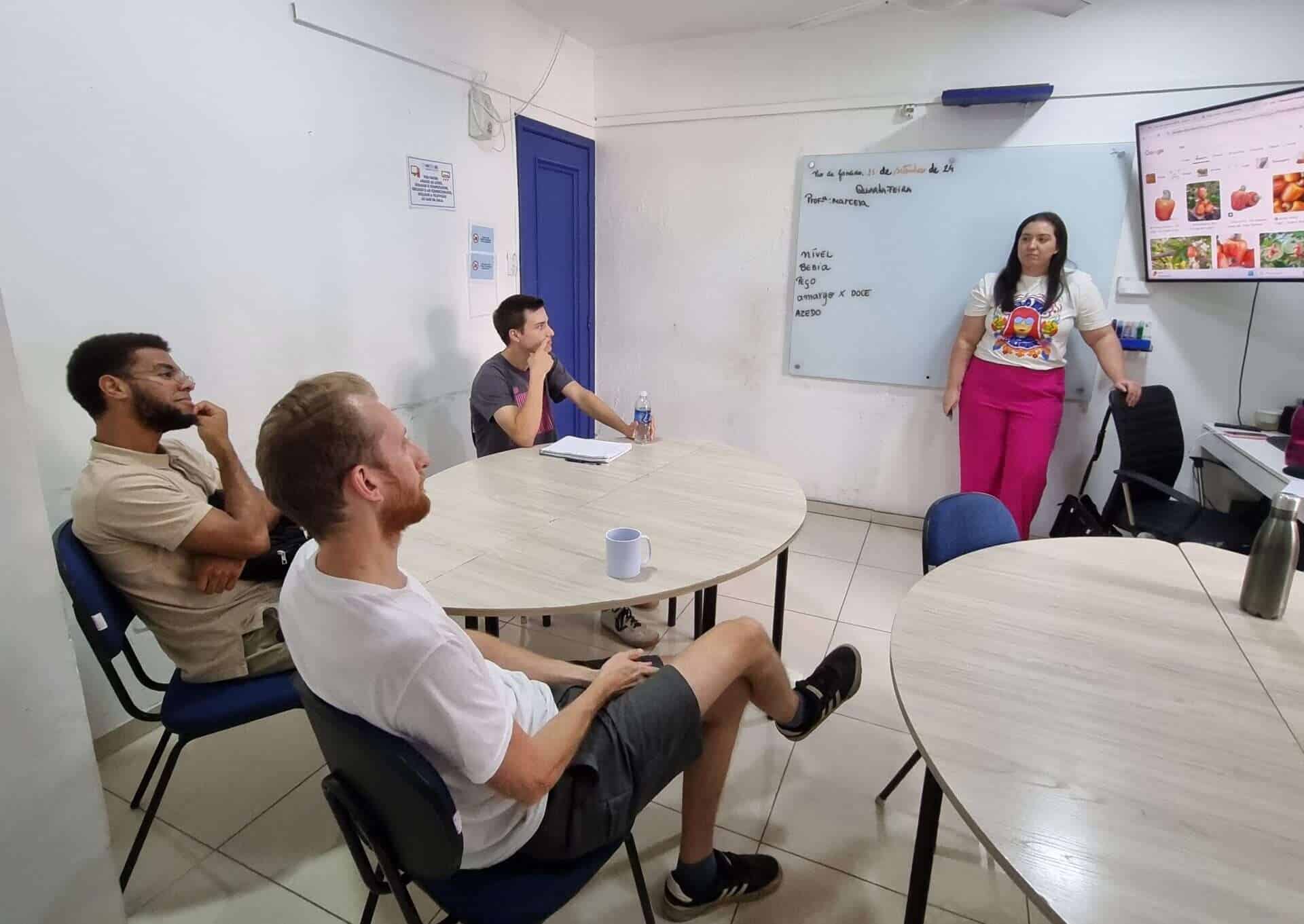
Portuguese classes might not be the first thing that comes to mind when you think about learning a second language. However, with over 220 million native speakers, Portuguese is one of the most spoken languages worldwide. Whether you’re planning to visit Brazil or simply want to broaden your language skills, taking Portuguese classes can be an exciting and rewarding experience.
At Caminhos Language Centre, we offer various options for Portuguese learners, including in-person classes, Portuguese online courses, and immersive experiences in Rio de Janeiro. Here’s why Caminhos is the perfect place for your Portuguese classes.
 Portuguese Classes to learn portuguese
Choosing to study in Brazil offers many advantages. Firstly, Brazil is a vibrant country with a rich culture, beautiful landscapes, and warm people. By taking Portuguese classes in Rio de Janeiro, you are not just learning a language—you are living the experience.
Caminhos Language Centre gives you the opportunity to explore the city and immerse yourself in the culture while practicing your Portuguese. Whether you’re enjoying a beach day at Copacabana or hiking through Tijuca Forest, you’ll have countless opportunities to interact with locals and use the language daily.
At Caminhos, we offer Portuguese courses for all levels—beginners to advanced. Our teachers are native speakers who create engaging and interactive classes to make learning fun and effective. The main course options include:
Group classes: Learn Portuguese in small groups with other students from around the world. You’ll practice speaking, listening, reading, and writing while making new friends.
Private lessons: These customized lessons offer you the flexibility to focus on your personal goals and work at your own pace.
Portuguese online courses: If you can’t come to Brazil, don’t worry! Our online classes allow you to learn Portuguese from anywhere in the world, with the same immersive experience.
The Best Way to Learn Portuguese Online
Learning Portuguese online is a convenient option for many students. With our online Portuguese courses, you’ll receive personalized attention from our experienced teachers, interactive lessons, and plenty of resources to enhance your language journey.
Our Portuguese online courses are flexible, so you can study at your own pace and choose the schedule that fits your lifestyle. Plus, you’ll still have access to cultural tips, online activities, and social events, keeping the experience immersive even from afar.
If you’re looking for a unique experience, Caminhos Language Centre also offers immersive Portuguese courses in Rio de Janeiro. You can learn the language while exploring one of the most beautiful cities in the world.
Participate in local activities, engage with the community, and enjoy the Brazilian lifestyle—all while improving your Portuguese skills. Our school organizes regular cultural tours and events, giving you a taste of authentic Brazil.
Caminhos Language Centre is the largest and most exciting Portuguese school in Rio de Janeiro, Brazil. We have an excellent infrastructure, over 15 experienced Brazilian teachers, and a friendly multilingual support staff. We are the only school in Brazil able to offer Portuguese group courses throughout the year on 10 different levels. Moreover, our school also offers more than just Portuguese lessons for foreigners, we offer you the complete Rio de Janeiro experience. Every day we organize 100% free and fun activities for you to socialize and practice your Portuguese. We can also help you with a student visa for Brazil and accommodation in Rio de Janeiro. Follow us on Instagram for some Portuguese tips and news.
[ad_2]
Source link
[ad_1]
[ad_2]
Source link
[ad_1]
[ad_2]
Source link

[ad_1]
[ad_2]
Source link
[ad_1]
The idea that language learning might become obsolete is one of those predictions that sparks excitement, fear, and a lot of debate.
Given the rapid development of translation technology – from Google Translate to AI-powered devices – some people, including myself, wonder if tech is making learning foreign languages obsolete.
But is that really the case? As a linguist, I find this question both intriguing and unsettling. Let me guide you through my considerations on this topic and let’s see if technology can truly replace the practice of learning a language.
It is undoubtable that translation technology has evolved in the last decade. I remember using clunky, inaccurate tools for my school homework not too long ago, and now we have apps and devices that can instantly translate spoken language in real-time.
It was 2019, I was living in Russia when I met a Chinese guy. He spoke no English, but we managed to communicate thanks to the then-brand-new Google Translate setting that allowed to speak and instantly translate. Now, this is an everyday activity, but only six years ago, I was shocked by it!
Although these tools have evolved, they’re not flawless. If you ever used Google Translate aiming at obtaining a nuanced conversation, I am sure you felt disappointed at least once.
Words are often mistranslated, idioms are often misunderstood, and the emotional undertones get lost. Even with AI advancements, technology still struggles with context and cultural subtleties.
For instance, translating the Italian idiom in bocca al lupo as “in the mouth of the wolf” doesn’t capture the aim of wishing someone good luck, as you would do with the English “break a leg”.
From my experience, translation technology can be a helpful tool, especially for travelers or in emergency situations. But let’s be clear: translations tech is a tool, not a replacement.
Language is not just about words, it’s about connection, culture, and understanding the human experience from a different perspective. For example, how can you truly understand the Italian culture without knowing the meaning behind the expressions magari?
This perspective caught my attention when I read a discussion on Reddit on whether language learning will become obsolete.
Most users expressed skepticism about technology’s ability to replace language learning entirely and argued that, despite the advancements, technologies are still far from grasping the complexities and nuances of human language.
To be honest, I totally agree with them! Especially in the most recent days, with the promise of Neuralink as the future of communication and learning, some might wonder if these innovations could revolutionize how we perceive languages.
Language learning goes beyond mere translation. When you learn a language, you gain insight into how people think, feel, and see the world. This helps explain the idea that you behave differently when you speak a different language.
Think of all those Italian words that have no equivalent in English: the word abbiocco, for example, describes the sleepy sensation that follows a large meal, something that the English translation “food coma” doesn’t fully capture.
This understanding adds depth to communication that no AI can replicate.
Multilingualism comes with cognitive benefits that technology simply can’t replicate. Studies show that learning a language improves memory, problem-solving skills, and even multitasking abilities. It also delays the onset of cognitive decline.
Moreover, there’s a unique social aspect: language classes, meetups, or even simple and random conversations with native speakers force us out of our comfort zones and foster human connections.
For instance, imagine the joy of understanding a joke in Italian or finally feeling confident ordering food in a market in Rome is irreplaceable. Could a device ever provide that feeling? I doubt it.
Imagine this scenario: you’re in a remote village in Italy, and your app suddenly stops working due to no internet connection. You’re left with the basic Italian basic vocabulary you learned in movies and body language.
Also, language is fluid and dynamic, constantly evolving with slang, new expressions, and cultural trends. AI struggles to keep up with these changes.
I know it is tempting to think that we’re moving towards a future where we’ll no longer need to learn languages, but, for me, the reality is more complex.
Translation technology will undoubtedly continue to improve, but it will never fully replicate the experience, benefits, and richness of learning a language.
Language learning is mainly about the human experience: the joy of discovery, the satisfaction of progress, and the beauty of connecting across cultures.
So, will language learning become obsolete? I’d say it’s just the opposite. As technology makes the world more accessible, the value of deep, meaningful human connections will increase even more.
And there’s no better way to connect than by speaking someone’s language.
[ad_2]
Source link