نویسنده: AliBina

  • Know All About Carnival in Brazil

    Know All About Carnival in Brazil

    [ad_1]

    If you want to learn all about Carnival in Brazil, search no more. In this blog post, we talk about the history of Carnival, the samba schools, and the best cities to visit during the Carnival season in Brazil. Moreover, we also teach you some Carnival vocabulary so you are prepared to celebrate in Brazil.

    History of Carnival in Brazil

    The origin of Carnival has to do with Christianity and its roots in the Middle Ages. Back then, people would wear masks and disguises to celebrate the time before Lent. Even today, Carnival still has a certain connection with Christianity, as the official date for this celebration changes every year according to the Christian calendar. We celebrate Carnival 40 days after Palm Sunday every year. That means Carnival usually falls by the end of February or the beginning of March.

    During colonial times, the Portuguese brought Carnival festivities to Brazil, especially Rio de Janeiro. With time, rich people were organizing masquerade balls in the country, making Carnival a popular season. Also around that time, people started to parade on the streets, wearing their masks and costumes. However, samba was not yet a thing.

    Read more: History And Types Of Samba In Brazil.

    The music people would play the most during Carnival season was marchinha, a genre of music that would serve as a comic satire of military marches. Nonetheless, by the end of the 19th century, samba started to grow among the slums of Rio de Janeiro and the general population. With time, it became the most popular genre of Carnival music.

    Not long after that, around the ’20s, the first samba schools were established in Rio de Janeiro.

    Meanwhile, in 1950 in Bahia, Carnival was growing differently than in Rio. With the invention of the trio elétrico, Carnival began to revolve around axé music, not samba. Trio elétrico is an adapted sound truck often used for street parties and large musical events.
    carnaval no brasil

    Samba Schools

    All About Carnival in Brazil - History, Where to Go & Vocabulary

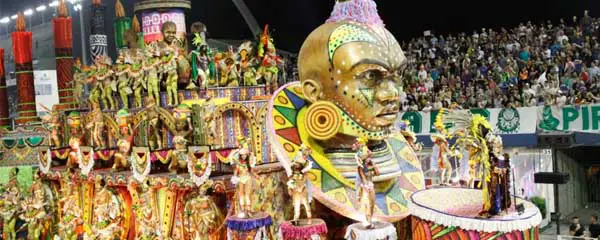
    Differently from what it might seem, the samba school has nothing to do with formal educational instruction. Samba schools are associations founded by civilians to praise samba and celebrate Carnival. They have a solid community basis and a strong bond with local neighborhoods or favelas.

    Around the ’30s, samba schools started to compete against each other, organizing the first parades.

    Nowadays, there are over 70 samba schools in Rio de Janeiro. Because of that, there are different leagues in the competition for the best school of the year. The Special League (Grupo Especial) is divided into two groups that parade on the Sunday and Monday of the Carnival season. They compete to crown the winner of the samba school parade every year. The parade lasts about one house and has to follow several rules. The Access League (Grupo de Acesso) parades on the Friday and Saturday before the Special League and competes to be promoted to the main league the following year.

    To sum it up, the samba school’s competition works just like a football state championship.

    The samba school’s competition is such a big deal nowadays, that they take over a year to prepare for their parades. That includes choosing a theme, doing research, creating floats and costumes, writing original songs and deciding which one to use, and more. Thousands of people are involved in the making of each samba school’s parade, such as designers, painters, seamstresses, woodworkers, musicians, choreographers, and much more.

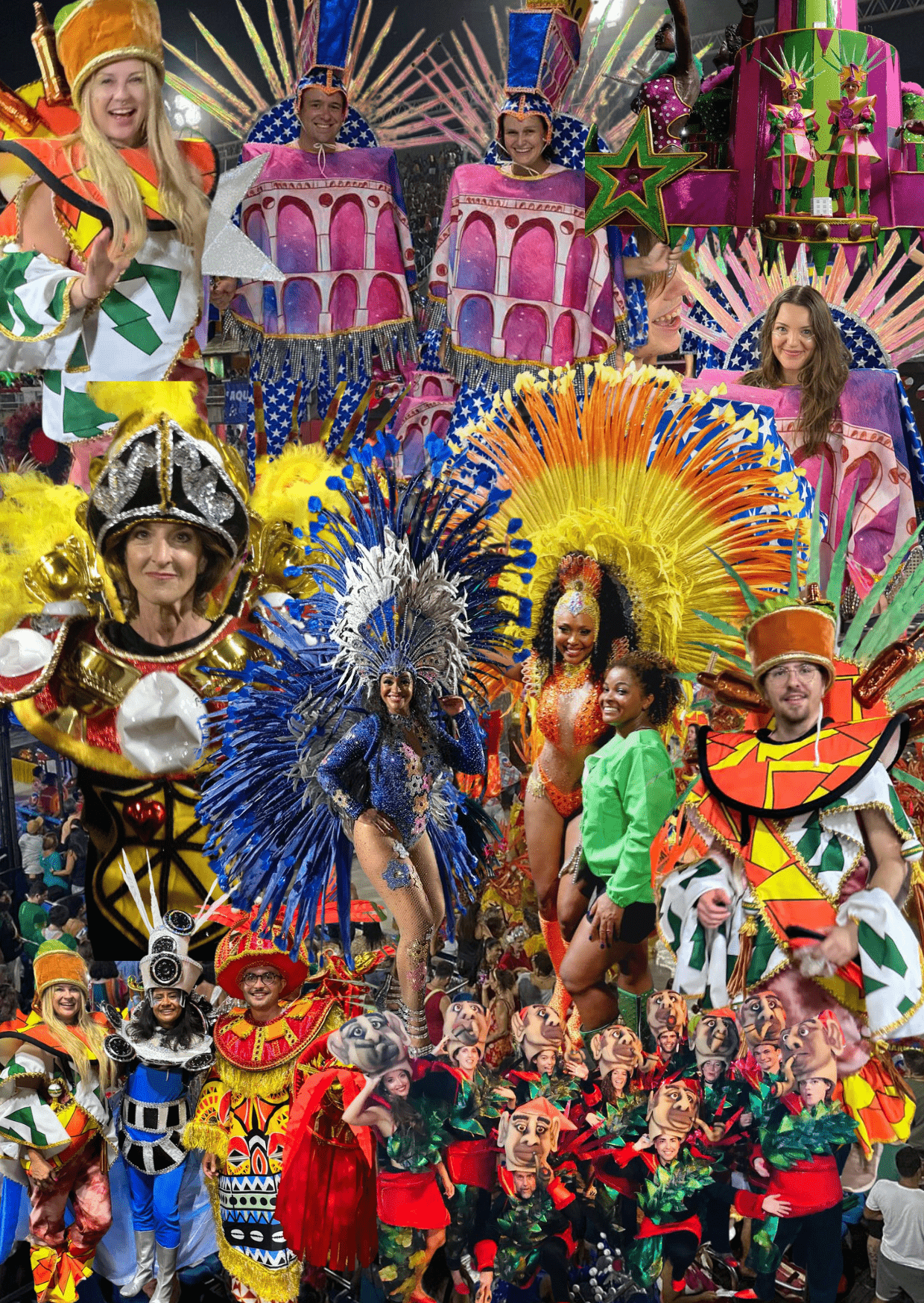
    • Fun Fact: Caminhos has been present at Sapucaí for 4 years. In partnership with the samba school, Arranco do Engenho de Dentro. We have taken our students on immersive journeys, allowing them to fully embrace the vibrant spirit of Brazilian culture during Carnival.

    Parades

    As stated above, the samba schools need to follow certain rules for their parades. Each Carnival organization decides on these rules. In Rio de Janeiro, for example, the parade has a maximum time of 70 minutes, with a minimum of 4 and a maximum of 6 Carnival floats.

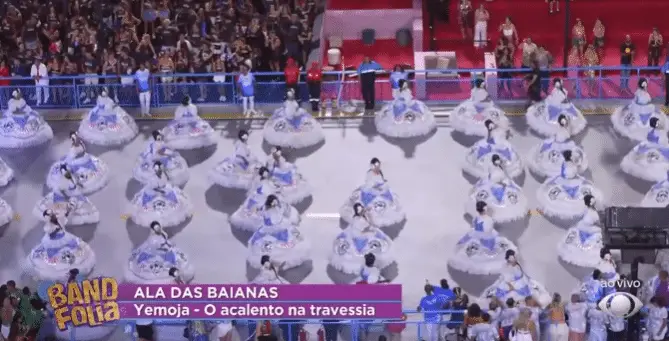
    The parade is divided into wings. No special wing is required, but some of them are traditional in every parade. For example, Ala das Baianas, in which ladies dress in clothes reminiscent of the early twentieth century. Also popular is Velha Guarda, a wing of only elderly people who once had honorable roles in the samba school, such as dancers, musicians, and directors.

    Each parade is judged and scored on:

    • Allegorical floats and props (Alegorias e adereços): The Carnival floats.
    • Drumming Section (Bateria): The Carnival orchestra of each school.
    • Front Commission (Comissão de Frente): The first group of participants in a parade. They dance to a well-rehearsed choreography to introduce the theme the samba school is presenting.
    • Plot-theme (Enredo): The theme each school is presenting.
    • Progression (Evolução): The pace and speed of the parade must be in sync with the music.
    • Costumes (Fantasias): The design and ideas for the clothes.
    • Harmony (Harmonia): Everyone at the parade must be singing and dancing.
    • Mestre-Sala and Porta-Bandeira: A couple with a special costume that dances while paying tribute to the samba school’s flag. Each school can have more than one couple honoring the flag, but only the main couple is judged.
    • Samba song (Samba-enredo): The original melody and lyrics composed for the parade.

    Sambadrome

    The sambadrome is the place where samba schools parade during Carnaval in Brazil. There are spectator viewing areas around the avenue and VIP suites that offer open bars and special attractions.

    Famous samba schools

    In Rio de Janeiro, some of the most popular and traditional samba schools are:

    • Portela – founded in 1923 – 22 titles
    • Mangueira – founded in 1928 – 20 titles
    • Beija-Flor – founded in 1948 – 14 titles
    • Salgueiro – founded in 1953 – 9 titles
    • Imperatriz Leopoldinense – founded in 1959 – 8 titles
    • Mocidade – founded in 1955 – 6 titles
    • Unidos da Tijuca – founded in 1931 – 4 titles
    • Unidos de Vila Isabel – founded in 1946 – 3 titles

    Further reading: Top 5: Main Traditional Brazilian Festivals.
    carnaval de brasil

    Blocos de Rua

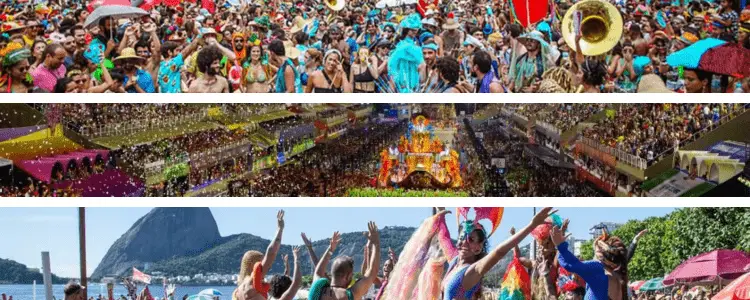
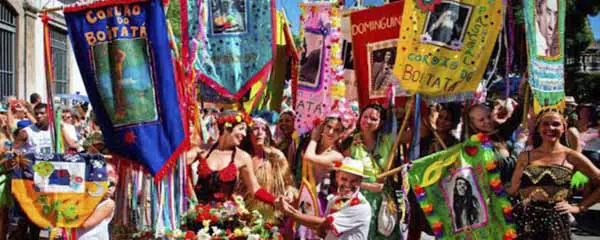
    Blocos de rua, also called bloquinhos or carnaval de rua are the street parades organized all around the city during Carnival season. Even though they are huge in Rio de Janeiro, blocos de rua are organized all over different cities in Brazil, such as São Paulo, Recife, Ouro Preto, and Florianópolis.

    Street bands followed by an adapted sound truck (trio elétrico) play lively, fast-paced, and energetic music. Even though many bands play samba, marchinha is the most popular music genre in blocos de rua.

    For example, there is a famous Carnival group in Brazil called Sargento Pimenta (Sergeant Pepper) that only plays Beatles songs. However, they use the marchinha beat while doing so.

    Watch the Sargento Pimenta band playing All My Loving Carnival-style:

    https://www.youtube.com/watch?v=WuU2R01Z98E

    Costumes

    The most important thing about Carnival is costumes.

    Since the beginning of Carnival celebrations in Brazil, masks were always part of the attire. By 1870 people were already using costumes to make their Carnival more fun. Yes, that was way before samba was even invented!

    So, you need to prepare for Carnival — one different costume a day. Be creative, use lots of glitters and colorful props. Do that and you are ready for Carnival!

    Where to Enjoy Carnival in Brazil?

    Rio de Janeiro

    In Rio de Janeiro you do not need to choose between watching the samba schools’ parade or enjoying the street Carnival because we have it all. You can join the blocos during the day and watch the parades in the evening. Rinse and repeat for four days straight!!! There are over 500 ‘blocos de rua’ in Rio and you will have the time of your life.

    Salvador

    If you want to try something different from samba, Salvador has the best axé music festivities during Carnival. Some Brazilians say everyone must spend at least one Carnival season in Salvador.

    Recife and Olinda

    One of the most traditional ways to celebrate Carnival is going to Recife and Olinda, sister cities in Pernambuco. The street Carnival is huge there, and you can try Frevo — the local music genre and dance. Guinness Book of World Records registered Galo da Madrugada, a bloco de rua in Recife, as the biggest carnival parade in the world. Over 2,500,000 people followed their parade in 2013.

    Watch Teacher Deise’s video on Pernambuco.

    Ouro Preto

    Ouro Preto is a small historical city in the state of Minas Gerais. The Carnival there is famous among young partygoers, especially college students. That is because Ouro Preto is also a university town. The street Carnival is great and the college dorms and fraternity houses also throw awesome parties.

    Carnival Vocabulary

    How About Carnival in 2025?

    In 2025, Carnival is set to return with renewed energy and vibrancy after the unprecedented challenges of recent years. Thanks to robust vaccination campaigns and improved public health protocols across Brazil, all traditional Carnival events are back on track. The mayor of Rio de Janeiro has confirmed that the street Carnival will proceed as scheduled, welcoming millions of revelers to enjoy the festivities safely. Additionally, the samba schools’ parade at the Sambadrome will dazzle audiences in its customary time slot, showcasing the rich cultural heritage and passion for Brazilian Carnival. Get ready for a celebration that truly reflects the resilient and joyful spirit of Rio de Janeiro!

    Experience the thrill of Rio de Janeiro’s Carnival at Sapucaí like never before with Caminhos and the samba school Arranco do Engenho de Dentro! Immerse yourself in the pulsating rhythms of samba, make unforgettable memories, and celebrate Carnival at its very heart. Be part of it all!

    Watch our series of videos on Carnival: part 1, part 2, part 3.

    If you are planning on coming to Rio de Janeiro for Carnival someday, how about arriving a few weeks early and learning some basic Portuguese to help you around the city? Caminhos Language Centre offers Portuguese group courses and private lessons to help you get a grasp of street Portuguese and Brazilian culture. We also have a 4-hour Portuguese crash course to help you with the basics.


    Caminhos Language Centre is the largest and most exciting Portuguese school in Rio de Janeiro, Brazil. We have an excellent infrastructure, over 15 experienced Brazilian teachers, and a friendly multilingual support staff. We are the only school in Brazil able to offer Portuguese group courses throughout the year on 10 different levels. Moreover, our school also offers more than just Portuguese lessons for foreigners, we offer you the complete Rio de Janeiro experience. Every day we organize 100% free and fun activities for you to socialize and practice your Portuguese. We can also help you with a student visa for Brazil and accommodation in Rio de Janeiro. Follow us on Instagram for some Portuguese tips and news.


    [ad_2]

    Source link
  • Core Words: How to Say “Candy,” “Meat,” and More!

    Core Words: How to Say “Candy,” “Meat,” and More!

    [ad_1]

    Hi everybody, my name is Thomas. Welcome to the 2000 Core Dutch Words and Phrases video series! Each lesson will help you learn new words, practice, and review what you’ve learned. Ok! Let’s get started! First is… WORD 1 (NORMAL SPEED) gerst (NORMAL SPEED) “barley” (NORMAL SPEED) gerst (SLOW) gerst (NORMAL SPEED) “barley” (NORMAL SPEED) Gerst wordt voor van alles gebruikt, van gezonde voeding tot bier en whisky. (NORMAL SPEED) “Barley is used for everything from health food to beer and whiskey.” (SLOW) Gerst wordt voor van alles gebruikt, van gezonde voeding tot bier en whisky. WORD 2 (NORMAL SPEED) vlees (NORMAL SPEED) “meat” (NORMAL SPEED) vlees (SLOW) vlees (NORMAL SPEED) “meat” (NORMAL SPEED) vlees fijnhakken (NORMAL SPEED) “chopping meat” (SLOW) vlees fijnhakken WORD 3 (NORMAL SPEED) zoetigheid (NORMAL SPEED) “sweets” (NORMAL SPEED) zoetigheid (SLOW) zoetigheid (NORMAL SPEED) “sweets” (NORMAL SPEED) Ik houd van zoetigheid, vooral chocolade. (NORMAL SPEED) “I like sweets, chocolate in particular.” (SLOW) Ik houd van zoetigheid, vooral chocolade. WORD 4 (NORMAL SPEED) snoep (NORMAL SPEED) “candy” (NORMAL SPEED) snoep (SLOW) snoep (NORMAL SPEED) “candy” (NORMAL SPEED) Op de verjaardag van mijn dochter hebben we een piñata gevuld met snoep. (NORMAL SPEED) “We are having a piñata filled with candy at my daughter’s birthday party.” (SLOW) Op de verjaardag van mijn dochter hebben we een piñata gevuld met snoep. WORD 5 (NORMAL SPEED) grapefruit (NORMAL SPEED) “grapefruit” (NORMAL SPEED) grapefruit (SLOW) grapefruit (NORMAL SPEED) “grapefruit” (NORMAL SPEED) Mijn moeder at altijd een halve grapefruit bij het ontbijt. (NORMAL SPEED) “My mother always ate half of a grapefruit at breakfast.” (SLOW) Mijn moeder at altijd een halve grapefruit bij het ontbijt. WORD 6 (NORMAL SPEED) veenbes (NORMAL SPEED) “cranberry” (NORMAL SPEED) veenbes (SLOW) veenbes (NORMAL SPEED) “cranberry” (NORMAL SPEED) gedroogde veenbes (NORMAL SPEED) “dried cranberry” (SLOW) gedroogde veenbes WORD 7 (NORMAL SPEED) gember (NORMAL SPEED) “ginger” (NORMAL SPEED) gember (SLOW) gember (NORMAL SPEED) “ginger” (NORMAL SPEED) De specerij gember wordt gebruikt bij het koken en als medicijn. (NORMAL SPEED) “The spice ginger is used for cooking and medicine.” (SLOW) De specerij gember wordt gebruikt bij het koken en als medicijn. WORD 8 (NORMAL SPEED) olijfolie (NORMAL SPEED) “olive oil” (NORMAL SPEED) olijfolie (SLOW) olijfolie (NORMAL SPEED) “olive oil” (NORMAL SPEED) olijfolie in een pot (NORMAL SPEED) “olive oil in a jar” (SLOW) olijfolie in een pot WORD 9 (NORMAL SPEED) kruid (NORMAL SPEED) “spice” (NORMAL SPEED) kruid (SLOW) kruid (NORMAL SPEED) “spice” (NORMAL SPEED) Kruiden en smaakmakers staan in gangpad zes. (NORMAL SPEED) “Spices and seasonings are on aisle six.” (SLOW) Kruiden en smaakmakers staan in gangpad zes. WORD 10 (NORMAL SPEED) saus (NORMAL SPEED) “sauce” (NORMAL SPEED) saus (SLOW) saus (NORMAL SPEED) “sauce” (NORMAL SPEED) Waar is de saus? (NORMAL SPEED) “Where is the sauce?” (SLOW) Waar is de saus? PRACTICE/REVIEW Let’s review. Respond to the prompts by speaking aloud. First, you will hear a word or phrase in English. Respond in Dutch, then repeat after me, focusing on pronunciation. Ready? (Do you remember how to say “barley?” Review 1) (3) (2) (1) gerst (1) gerst (And how to say “meat?” Review 2) (3) (2) (1) vlees (1) vlees (What about “sweets?” Review 3) (3) (2) (1) zoetigheid (1) zoetigheid (Do you remember how to say “candy?” Review 4) (3) (2) (1) snoep (1) snoep (Let’s try “grapefruit!” Review 5) (3) (2) (1) grapefruit (1) grapefruit (What about “cranberry?” Review 6) (3) (2) (1) veenbes (1) veenbes (Now, let’s see if you remember how to say “ginger!” Review 7) (3) (2) (1) gember (1) gember (Another one! What about “olive oil?” Review 8) (3) (2) (1) olijfolie (1) olijfolie (Do you remember how to say “spice?” Review 9) (3) (2) (1) kruid (1) kruid (And finally, do you remember how to say “sauce?” Review 10) (3) (2) (1) saus (1) saus Well done! See you next time! Tot ziens.


    [ad_2]

    Source link

  • How to Learn & Master Russian Grammar with our Grammar Bank

    How to Learn & Master Russian Grammar with our Grammar Bank

    [ad_1]

    If you’re tired of knowing and speaking the language at a basic level… …and want to express yourself fluently, just like native speakers… …then, you’ll need to learn grammar. The problem? It can be tricky to learn. But don’t worry. In this guide, you’ll discover… Where to get all of the grammar explanations you’ll ever need… The best way to learn grammar that’s right for your level… And how to expose yourself to real examples until the rules become natural to you …with a study tool called the Grammar Bank inside of our learning program. But first, if you don’t yet have access to our program… Sign up for a free lifetime account right now. Just click the link in the description. So, what is the grammar bank? The grammar bank is like a grammar dictionary, except online. It’s a database of the must-know grammar rules and explanations… …that makes it easy to look up specific rules and learn them. Look for it in the top menu of our site. How do you learn grammar with it? The best way to learn grammar is NOT to just study roles… But to learn in context…and hear the grammar used in real life. And that’s exactly how you learn with our lessons. You learn a quick conversation and hear how the grammar rules are used within that conversation. But what if you come across grammar that you’re not familiar with? Or what if you want to review a specific rule… without going back to re-do a lesson? That’s where the grammar bank comes in. You can look up grammar rules, and get the explanations, examples… and links to lessons where we cover these rules. You can also sort grammar by learning level. So, if you’re an Absolute Beginner and want to make sure you know all of the Absolute Beginner grammar rules… …you can do just that with the Grammar bank. You can also sort the rules by spelling, category, and lesson series. And if you want to get used to the grammar patterns so that you can use them in conversation… and become fluent… The best way is to expose yourself to examples as much as possible. Grammar is hard at first… but gets easy once you get used to it with enough exposure. Be sure to access the related lessons inside the grammar bank… …and listen to the native conversations that use the rule… as much as possible. So, if you want to become fluent and speak perfectly… you’ll need grammar… Take advantage of the Grammar Bank… inside of our learning program But if you don’t yet have access… sign up for a free lifetime account right now. Just click the link in the description to sign up.


    [ad_2]

    Source link

  • What does “Suggestivo” mean in Italian? (false friend)

    [ad_1]

    Beware of Italian False Friends

    Learning a new language is fun, but what I find the funniest is when learners use a wrong word in a context because it resembles another word in their native language. It happened to me as well, several times! And the best way to overcome this issue is to laugh about it.

    These words are so-called false friends and they can easily lead to misunderstandings. One such example in Italian is the word suggestivo. Let’s dive into its true meaning, usage, and other common false friends in Italian that learners should be aware of.

    Understanding “Suggestivo”

    What Does “Suggestivo” Really Mean?

    The Italian suggestivo translates to “evocative”, “inspiring”, or “pleasing in a marvelous way”. It is used to describe something that creates a strong emotional response, often associated with beauty or charm.

    It is not the same as the English word “suggestive”, which implies something with sexual undertones. If you want to convey the sexual connotation of the English “suggestive”, you can use the Italian term provocante in Italian.

    How to use “Suggestivo” in Italian

    Suggestivo is frequently used to describe scenic locations, artworks, or experiences that are emotionally striking or particularly beautiful.

    I like using this word a lot, especially when referring to nature. As a sunset lover, I find suggestivo the perfect term to describe the colors of the sky at the end of a day.

    Questo tramonto è suggestivo.

    This sunset is evocative.

    As with many other aspects of language learning, understanding the subtle differences in word usage is essential. It helps you avoid embarrassing mistakes and allows for more precise and culturally appropriate communication.

    Appreciate the Nuances of Italian

    The word suggestivo is a reminder of how learning Italian requires more than just memorizing vocabulary: it’s about understanding context, culture, and subtle meanings.

    Words like this show how language can shape and reflect different ways of experiencing the world. It is a concrete example that highlight that languages do affect our behaviors and perspectives!

    Embracing these nuances and gain a richer, more authentic appreciation of the Italian language.

    [ad_2]

    Source link

  • Best Cities to Celebrate Carnival in Brazil

    [ad_1]

    If you are planning to spend Carnival in Brazil, you are probably very excited to experience it all! Let’s check Best Cities to Celebrate Carnival in Brazil

    [ad_2]

    Source link

  • Core Words Lesson #43 — Quiz Review

    Core Words Lesson #43 — Quiz Review

    [ad_1]

    Unlock In-Depth Explanations & Exclusive Takeaways with Printable Lesson Notes

    Unlock Lesson Notes and Transcripts for every single lesson. Sign Up for a Free Lifetime Account and Get 7 Days of Premium Access.


    [ad_2]

    Source link

  • Free Turkish Gifts of the Month – April 2025

    Free Turkish Gifts of the Month – April 2025

    [ad_1]

    Access your free language gifts right now before they expire. First, 30 plus words and phrases for April Fool’s Day. This PDF will teach you how to say, that’s not funny, I don’t get it, and much more just in time for April Fool’s Day. Second, being funny, PDF conversation cheat sheet. This next PDF teaches you a quick conversation about telling jokes in your target language. Third, talking about months. If you can’t say the months, this one minute lesson will teach you how to say them all in your target language. Fourth, 15 flattering lines to impress native speakers. If you want to speak with natives, you’ll want to know these phrases. And fifth, want an app that gets you speaking from day one? The Innovative Language Learning app gives you bite-sized conversation lessons, where you listen to conversations between real native speakers and then get everything explained so you can speak and understand fast. Download it for free on Android, iPhone, and iPad. To get your free gifts of the month, click the link in the description below and download them now before they expire.


    [ad_2]

    Source link

  • Asking for Information in a Russian Office

    Asking for Information in a Russian Office

    [ad_1]

    INTRODUCTION John: Hi everyone, and welcome back to RussianPod101.com. This is Business Russian for Beginners Season 1 Lesson 10 – Asking for Information in a Russian Office. I’m John. Karina: Привет, I’m Karina. John: In this lesson, you’ll learn how to ask for a simple piece of information in your workplace. The conversation takes place at the office. Karina: It’s between Linda and Anna. John: The speakers are co-workers, so they will use informal Russian. Okay, let’s listen to the conversation. DIALOGUE Линда: Ты знаешь телефон Елены? Анна: Да, её рабочий телефон 84951234567. Линда: Я пыталась дозвониться, но её не было. Ты не знаешь её мобильный? Анна: Конечно, 89141234567 и её адрес электронной почты elena@mail.com. John: Listen to the conversation one time slowly. Линда: Ты знаешь телефон Елены? Анна: Да, её рабочий телефон 84951234567. Линда: Я пыталась дозвониться, но её не было. Ты не знаешь её мобильный? Анна: Конечно, 89141234567 и её адрес электронной почты elena@mail.com. John: Listen to the conversation with the English translation Linda: Do you know Elena’s telephone number? Anna: Yes, her office number is 84951234567. Linda: I tried earlier, but she was not in. Do you also know her mobile phone number? Anna: Sure, it’s 89141234567 and her email address is elena@mail.com. POST CONVERSATION BANTER John: Are office transfers common in Russia? Karina: Despite the fact that Russia is the biggest country in the world, office transfers are not that common. John: Is there a specific reason for that? Karina: It may be because according to Russian Labor Law, a job transfer is possible only with an employee’s written agreement. Of course for some types of jobs, like in the oil and gas industry, job transfers are a usual thing. John: I see. Are there any other reasons? Karina: Another explanation for a low number of job transfers may be the fact that Russians have very strong family values and don’t really like working far away from home. John: What’s the Russian for “office transfer”? Karina: перевод по работе John: Okay, now onto the vocab. VOCAB LIST John: Let’s take a look at the vocabulary from this lesson. The first word is.. Karina: знать [natural native speed] John: to know Karina: знать[slowly – broken down by syllable] Karina: знать [natural native speed] John: Next we have.. Karina: телефон [natural native speed] John: phone Karina: телефон[slowly – broken down by syllable] Karina: телефон [natural native speed] John: Next we have.. Karina: рабочий [natural native speed] John: working, office Karina: рабочий[slowly – broken down by syllable] Karina: рабочий [natural native speed] John: Next we have.. Karina: пытаться [natural native speed] John: to try, to make an attempt Karina: пытаться[slowly – broken down by syllable] Karina: пытаться [natural native speed] John: Next we have.. Karina: мобильный [natural native speed] John: mobile Karina: мобильный[slowly – broken down by syllable] Karina: мобильный [natural native speed] John: And last.. Karina: электронная почта [natural native speed] John: email Karina: электронная почта[slowly – broken down by syllable] Karina: электронная почта [natural native speed] KEY VOCAB AND PHRASES John: Let’s have a closer look at the usage of some of the words and phrases from this lesson. The first phrase is.. Karina: пытаться дозвониться John: meaning “to try to reach somebody on the phone.” The phrase consists of two verbs – “to try” and “to reach somebody on the phone.” Karina: Notice that the second verb дозвониться consists of the prefix до John: meaning “to complete something,” which is typical of perfective verbs Karina: and the verb звонить meaning “to call”, and the suffix ся John: Which brings the meaning “to do something by yourself.” Can you give us an example using this phrase? Karina: Sure. For example, you can say.. Я пытался дозвониться ей всё утро. John: ..which means “I’ve tried to reach her on the phone all morning.” Okay, what’s the next word? Karina: конечно John: meaning “sure” Karina: You use this word to show the 100% certainty of a speaker, and there are no limitations on the usage of this word. John: Can you give us an example using this word? Karina: Sure. For example, you can say.. Конечно, мы придём. John: .. which means “Of course, we are coming.” Okay, next let’s take a look at how to read an email address in Russian Karina: elena@mail.com John: which is “elena@mail.com” In Russian, as you may have noticed, mail addresses are written with the Latin alphabet, so be sure you know how to read the various parts. “@” is… Karina: собака John: “dot” is… Karina: точка John: “com” is… Karina: ком. Other common domains are орг for “org” and ру for “ru” John: Can you give us a sample sentence? Karina: Sure. For example, you can say.. Самый популярный домен в России – точка ру.” John: .. which means “The most common domain in Russia is dot-r-u”. Okay, now onto the lesson focus.

    Lesson focus

    John: In this lesson, you’ll learn about how to ask for a simple piece of information at the workplace. Karina: The example in the dialogue is Ты знаешь телефон Елены? John: “Do you know Elena’s telephone number?” Karina: The formula for questions like this is ты meaning “you” followed by знаешь “know” and a phrase… John: Usually an accusative noun combined with a genitive noun. Karina: In this example, телефон meaning “phone” is accusative and indicates an object, while Елены “Elena’s” is the genitive and specifies possession. John: The sentence we just talked about is used in informal speech. What if you need to ask a similar thing to your boss? Karina: In that case, you have to use the polite вы “you” and also add the negative не, “not,” to make it more polite, for example Вы не знаете телефон Елены? John: literally “Don’t you know Elena’s phone number?” Karina: here is another example – Вы знаете адрес электронной почты Фёдора? John: “Do you know Fyodor’s email address?” Now let’s take a look at the Russian verb meaning “to know.” Karina: знать John: There’s nothing difficult about this word, but the conjugations can be a bit challenging. Karina: We saw the second person singular Ты знаешь John: meaning “you know”, and which is used in informal situations Karina: and the second person plural Вы знаете John: meaning “you know” plural or polite. These are in the present tense, right? Karina: That’s right. John: In Russian there is only one present tense – Present Simple. If you learn the endings for the conjugations, you should be able to conjugate any verb. Karina: Right, first of all, you need to define whether the verb is of the first conjugation, where it doesn’t have и in infinitive form before ть, or the second, where it does. Then for the first conjugation, remove ть and add the right ending. For the second conjunction, remove ить and add the right ending. John: Which conjugation is the verb “to know”? Karina: знать is from the first conjugation. John: Let’s go through the complete conjugation and see the endings for the first conjugation verbs. “I know” is… Karina: Я знаю, the ending is -ю John: “you know” is… Karina: Ты знаешь, the ending is -ешь John: “he, she knows” is… Karina: Он / она знает and the ending is -ет John: “we know” is… Karina: Мы знаем and the ending is -ем John: “you know” plural or polite is… Karina: Вы знаете and the ending is -ете John: “They know” is… Karina: Они знают and the ending is -ют John: Are the endings for the second conjugation different? Karina: Yes, except for the first person singular, they are different. John: Let’s list them, for the first person “I” in both cases is… Karina: -ю or -у John: for the second person “you” singular is… Karina: -ешь for the first conjugation and -ишь for the second John: for the third person “he” or “she” is… Karina: -ет for the first conjugation and -ит for the second John: for the first person, “we” is Karina: -ем for the first conjugation and -им for the second John: for the second person “you” plural is.. Karina: -ете for the first conjugation and -ите for the second John: for the third person, “they” is… Karina: -ют or -ут for the first conjugation and -ят or -ат for the second

    Outro

    John: Okay, that’s all for this lesson. Thank you for listening, everyone, and we’ll see you next time! Bye! Karina: Пока!


    [ad_2]

    Source link

  • Will Language Learning Become Obsolete in the Future?

    [ad_1]

    Will Language Learning Become Obsolete? A Personal Reflection

    The idea that language learning might become obsolete is one of those predictions that sparks excitement, fear, and a lot of debate.

    Given the rapid development of translation technology – from Google Translate to AI-powered devices – some people, including myself, wonder if tech is making learning foreign languages obsolete.

    But is that really the case? As a linguist, I find this question both intriguing and unsettling. Let me guide you through my considerations on this topic and let’s see if technology can truly replace the practice of learning a language.

    Translation Technology

    Translating Then and Translating Today

    It is undoubtable that translation technology has evolved in the last decade. I remember using clunky, inaccurate tools for my school homework not too long ago, and now we have apps and devices that can instantly translate spoken language in real-time.

    It was 2019, I was living in Russia when I met a Chinese guy. He spoke no English, but we managed to communicate thanks to the then-brand-new Google Translate setting that allowed to speak and instantly translate. Now, this is an everyday activity, but only six years ago, I was shocked by it!

    Although these tools have evolved, they’re not flawless. If you ever used Google Translate aiming at obtaining a nuanced conversation, I am sure you felt disappointed at least once.

    Words are often mistranslated, idioms are often misunderstood, and the emotional undertones get lost. Even with AI advancements, technology still struggles with context and cultural subtleties.

    For instance, translating the Italian idiom in bocca al lupo as “in the mouth of the wolf” doesn’t capture the aim of wishing someone good luck, as you would do with the English “break a leg”.

    Translation Tech is a Tool, Not a Replacement

    From my experience, translation technology can be a helpful tool, especially for travelers or in emergency situations. But let’s be clear: translations tech is a tool, not a replacement.

    Language is not just about words, it’s about connection, culture, and understanding the human experience from a different perspective. For example, how can you truly understand the Italian culture without knowing the meaning behind the expressions magari?

    This perspective caught my attention when I read a discussion on Reddit on whether language learning will become obsolete.

    Most users expressed skepticism about technology’s ability to replace language learning entirely and argued that, despite the advancements, technologies are still far from grasping the complexities and nuances of human language.

    To be honest, I totally agree with them! Especially in the most recent days, with the promise of Neuralink as the future of communication and learning, some might wonder if these innovations could revolutionize how we perceive languages.

    As a linguist, I see language as an intrinsic part of human cognition, culture, and identity that no technological solution can fully replicate. The richness of language comes from its ability to express thoughts and emotions that are deeply rooted in human experience.

    Neuralink or AI might aid in understanding or translating languages, but they cannot replace the personal growth, empathy, and cultural immersion that come from learning a language.

    The True Value of Language Learning

    Language learning goes beyond mere translation. When you learn a language, you gain insight into how people think, feel, and see the world. This helps explain the idea that you behave differently when you speak a different language.

    Think of all those Italian words that have no equivalent in English: the word abbiocco, for example, describes the sleepy sensation that follows a large meal, something that the English translation “food coma” doesn’t fully capture.

    This understanding adds depth to communication that no AI can replicate.

    Why you Should not Fully Rely on Technology

    Cognitive and Social Benefits

    Multilingualism comes with cognitive benefits that technology simply can’t replicate. Studies show that learning a language improves memory, problem-solving skills, and even multitasking abilities. It also delays the onset of cognitive decline.

    Moreover, there’s a unique social aspect: language classes, meetups, or even simple and random conversations with native speakers force us out of our comfort zones and foster human connections.

    For instance, imagine the joy of understanding a joke in Italian or finally feeling confident ordering food in a market in Rome is irreplaceable. Could a device ever provide that feeling? I doubt it.

    The Limitations of Technology

    Imagine this scenario: you’re in a remote village in Italy, and your app suddenly stops working due to no internet connection. You’re left with the basic Italian basic vocabulary you learned in movies and body language.

    Also, language is fluid and dynamic, constantly evolving with slang, new expressions, and cultural trends. AI struggles to keep up with these changes.

    The Future of Language Learning

    I know it is tempting to think that we’re moving towards a future where we’ll no longer need to learn languages, but, for me, the reality is more complex.

    Translation technology will undoubtedly continue to improve, but it will never fully replicate the experience, benefits, and richness of learning a language.

    Language learning is mainly about the human experience: the joy of discovery, the satisfaction of progress, and the beauty of connecting across cultures.

    So, will language learning become obsolete? I’d say it’s just the opposite. As technology makes the world more accessible, the value of deep, meaningful human connections will increase even more.

    And there’s no better way to connect than by speaking someone’s language.

    [ad_2]

    Source link

  • Spiegel Highlights Our Epic Parade

    Spiegel Highlights Our Epic Parade

    [ad_1]

    Gerald Traufetter, a German Journalist for the Spiegel newspaper, shared his captivating experience parading with the samba school at Sambadrome. His words paint a vivid picture of the sheer energy and emotional intensity of the Carnival. For an immersive cultural experience, our students paraded with Arranco.

    What was the experience like to parade at the Sambadrome during Rio’s Carnival?

    Our group enters the Sambadrome, a 700-meter avenue surrounded by towering grandstands. At the end of it, I see the great curved arch marking the finish line of the parade. On that Friday night, it feels like the horizon where the world ends. The rhythm of the drums pulls us in like a vortex into this canyon of euphoria. A frenzy and a joy as if there were no tomorrow. – Gerald Traufetter.

    Read the full article: Feiern, während die Welt ins Wanken gerät

    A German Journalist’s Carnival Journey

    Traufetter’s article, “Celebrating While the World Crumbles“, delves into the surreal contrast of joyous celebration amidst global turmoil. He highlights the electric atmosphere from the moment the fireworks signaled the start of the parade, and the drums ignited a wave of movement. 

    Gerald Traufetter, captivated by the allure of Rio, embarked on a personal experiment: to fully immerse himself in the Carnival experience. He chronicles his journey from observer to participant, sharing his unique perspective on experiencing this vibrant cultural phenomenon.

    Rio Carnival Experience

    The Energy of the Parade

    “A show of fireworks gives the starting signal. Then the drums of the bateria start playing, and as if someone had pressed a button, the dancers start moving. Finally, it begins.” – Gerald Traufetter

    Traufetter vividly describes the electrifying moment the parade commences. He captures the contagious energy that pulsates through the Sambadrome, drawing everyone into a collective rhythm. He recounts the instructions from Patricia, our director, emphasizing the importance of not just smiling, but truly “shining” to embody the spirit of Carnival.

    Rio's Carnival

    Celebrating Amidst Global Uncertainty

    “The night began with a shock, coming from far beyond the horizon. In Washington, US President Donald Trump and his deputy, J.D. Vance, were publicly humiliating Ukrainian President Volodymyr Zelensky.” – Gerald Traufetter

    Traufetter’s experience wasn’t solely focused on the joyous celebration. He grapples with the contrast between the festive atmosphere and the unsettling global events unfolding simultaneously. He questions the ability to celebrate while the world seems to teeter on the brink of chaos. Yet, he finds solace and a sense of unity within the Carnival’s embrace.

    ”Once in a life time experience! Rhythm and Samba in the heart, soul and in the hips! I am very greatful that I found this wonderful language school Caminhos to give me very very good courses and this great opportunity to be part of a Samba School and to feel, see, learn what all this means to the Carioca people here. Thank you Caminhos for this incredible experience. Obrigada” – Andrea Regina K. from Darmstadt Germany (Caminhos Student)

    Rio's Carnival

    Embracing the “Fome” (hunger)

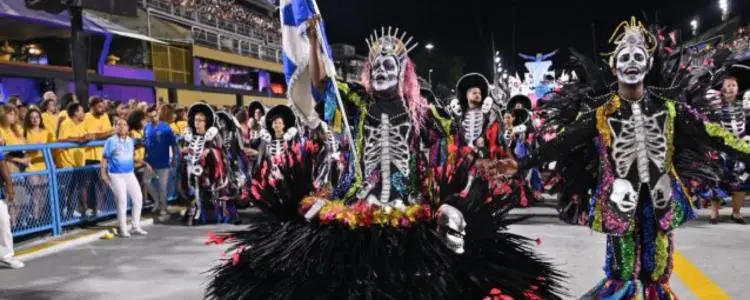
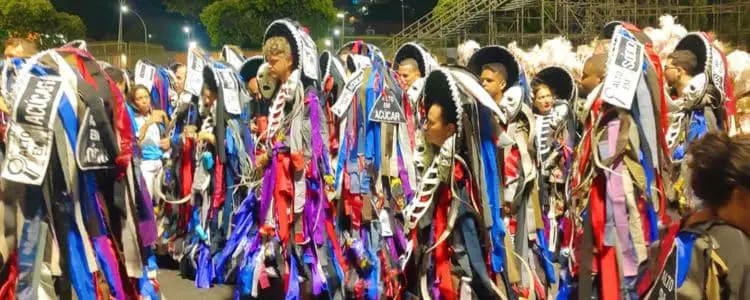
    “Patricia hands us our costumes: a big black garbage bag. ‘Everything’s fine,’ she says. Inside the bag, there is a suit made of strips of dark fabric, with a skeleton printed on the front. The costume is complemented by a huge hood adorned with two skulls on the sides. ‘You represent Hunger,’ says Patricia, smiling.” – Gerald Traufetter

    Traufetter humorously recounts receiving his “Fome” (Hunger) costume, which starkly contrasts with the vibrant colors and joyous themes typically associated with Carnival. He reflects on the symbolism, acknowledging that even amidst celebration, life includes both joy and hardship.

    Sapucaí

    The Story Behind the Parade: “Mães que Alimentam o Sagrado”

    In 2025, Arranco do Engenho de Dentro presented the theme “Mães que Alimentam o Sagrado” (Mothers Who Feed the Sacred), crafted by the talented carnival designer Annik Salmon. This theme celebrated the multifaceted nature of motherhood in Brazil, emphasizing the strength, faith, and dedication of mothers in nurturing their families and communities. The school’s performance was structured in four main sectors:

    1. Ancestrality: This sector delved into the deep roots of motherhood, tracing its origins back to Africa and honoring the powerful female deities in Afro-Brazilian religions. Figures like Yemanjá, Ọ̀ṣùn, and other Ìyás (mothers) were represented, showcasing their role as keepers of wisdom and tradition.Rio's Carnival
    2. Plurality: A vibrant celebration of the diverse faces of motherhood in Brazil. From the Baianas preparing their traditional feijoada to indigenous women who cultivated essential foods like açaí and mandioca, this sector showcased the beautiful tapestry of cultures and culinary traditions woven together by mothers.Rio's Carnival
    3. Resistance: This poignant sector paid homage to the strength and resilience of mothers who face immense challenges. It honored the women working tirelessly in the fields, markets, and kitchens, ensuring their families are nourished and their cultural heritage preserved.Rio's Carnival
    4. Sustainability and Creativity: A Look towards the Future, this sector highlighted the ingenuity of mothers in creating a sustainable world for their children. It showcased initiatives of recycling and resourcefulness, symbolizing the care and dedication mothers have for future generations.Rio's Carnival

    The samba-enredo (theme song) beautifully captured these themes, with lyrics like “I have the blood of a queen, nourished by the sacred,” resonating with the powerful message of the parade.

    A Deeper Look into Arranco’s History and Culture

    Arranco originates from Engenho de Dentro, a neighborhood with a rich history rooted in Portuguese colonization and African heritage. This blend of cultures is the essence of the Brazilian Carnival. The influence of Candomblé, an Afro-Brazilian religion, adds to the neighborhood’s unique cultural tapestry.

    Read more: History And Types Of Samba In Brazil.

    Rio's Carnival

    Our Continued Carnival Journey

    This marked our fourth year participating in the parade with this wonderful Samba school, and each year has been an unforgettable experience. Each year with a new and exciting “Enredo”(plot). The energy, the community, and the sheer joy of Carnival are truly unique. We are looking forward to the next year.

    Rio's Carnival

    If you are interested in studying Portuguese in Brazil, join Caminhos Language Centre, the largest and most exciting Portuguese school in Rio de Janeiro. We offer different types of group and private classes, and free after-class activities every day, promoting interaction between students and locals.

    Caminhos also offers online classes, so you can learn Portuguese wherever you are with native teachers and exclusive material.


    Caminhos Language Centre is the largest and most exciting Portuguese school in Rio de Janeiro, Brazil. We have an excellent infrastructure, over 15 experienced Brazilian teachers, and a friendly multilingual support staff. We are the only school in Brazil able to offer Portuguese group courses throughout the year on 10 different levels. Moreover, our school also offers more than just Portuguese lessons for foreigners, we offer you the complete Rio de Janeiro experience. Every day we organize 100% free and fun activities for you to socialize and practice your Portuguese. We can also help you with a student visa for Brazil and accommodation in Rio de Janeiro. Follow us on Instagram for some Portuguese tips and news.


    [ad_2]

    Source link